


Dubai Professional License: Requirements, Activities & Process
Most people assume starting a business in Dubai means trading licenses, products, or inventory.
It doesn’t.
If your business runs on what you know rather than what you sell, such as consulting, coaching, design, tech, advisory, or training, then a professional license in Dubai is the license that quietly powers a huge part of the UAE economy. And yet, it’s one of the most misunderstood.
Some believe it restricts ownership.
Others think it’s only for freelancers.
Many confuse it with a commercial license and pick the wrong structure, then spend months fixing it.
The truth? A professional license is designed for individuals and firms that sell expertise, judgment, and services, not goods. When structured correctly, it allows you to operate legally, invoice clients, hire staff, and scale, without forcing your business into a trading framework that doesn’t fit.
But here’s where it gets tricky.
The rules change depending on Dubai vs Abu Dhabi, mainland vs free zone, and whether your activity needs special approvals. Miss one detail, and your application slows down, or worse, gets approved under the wrong category.
This guide cuts through the noise.
We’ll break down what a professional license actually means in the UAE, who it’s meant for, how it differs from a commercial license, and what you should get right before you apply.
If your business is built on skill, not stock, read this before you register anything.
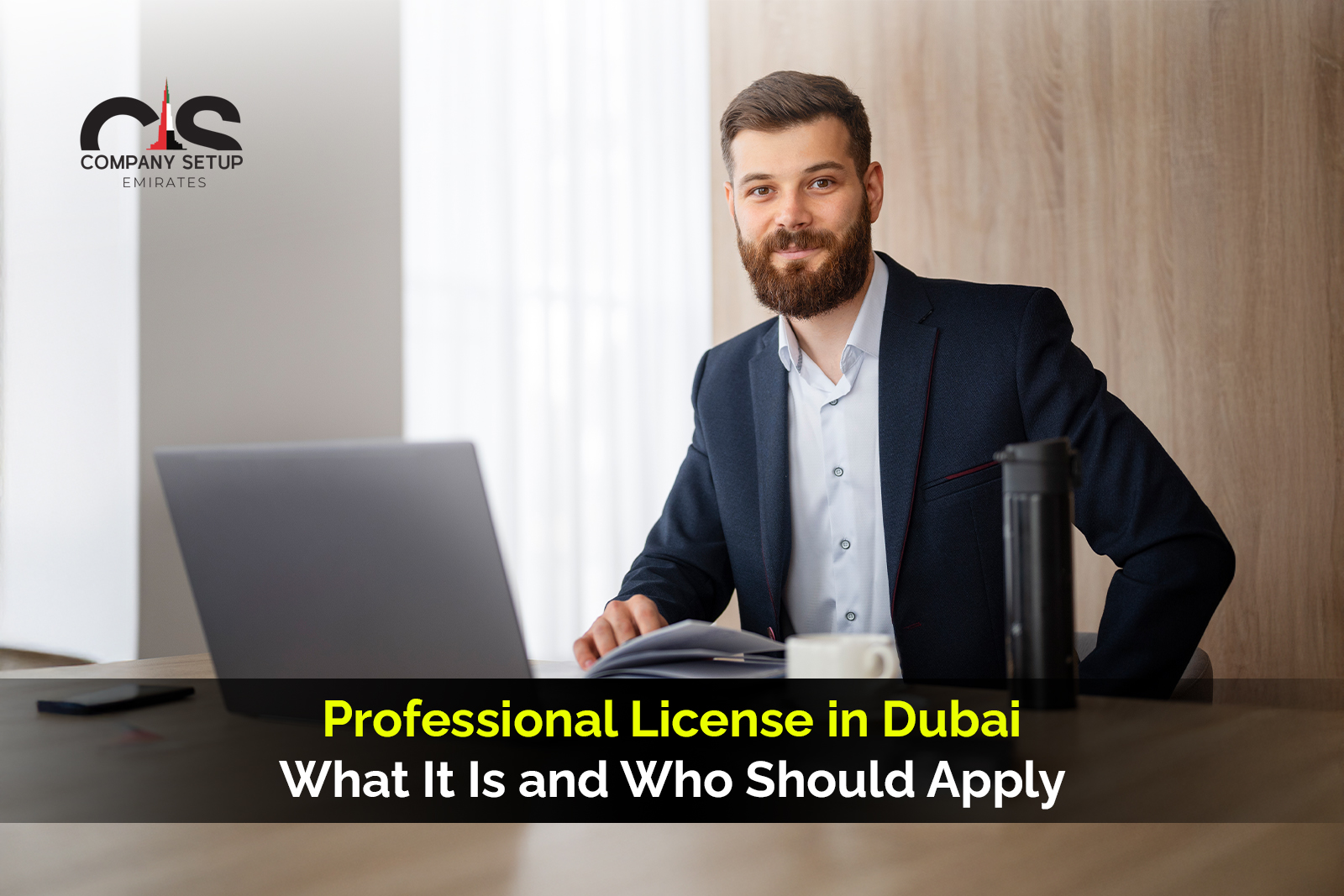
What is a Professional License in Dubai
A Professional License in Dubai is a mandatory authorisation issued by the Department of Economy and Tourism (DET) for individuals and companies that provide professional, service-based, or skill-driven activities. This license is designed specifically for businesses where the primary offering is expertise, knowledge, or specialised skills rather than the trading of physical goods.
Professional licenses are commonly issued to consultants, engineers, doctors, designers, artists, IT specialists, trainers, and other service professionals whose work is based on qualifications and experience. Unlike commercial or industrial licenses, a professional license focuses on intellectual and professional services, making it the most suitable option for experts looking to operate legally in Dubai’s mainland jurisdiction.
One of the key advantages of a professional license in Dubai is the ability to retain 100% foreign ownership. Under current UAE regulations, most professional activities no longer require a local partner to hold equity in the business. In certain cases, a Local Service Agent (LSA) may still be required. However, the LSA does not have ownership rights or profit-sharing authority and is only appointed to facilitate government and administrative procedures.
This structure allows professionals to maintain full operational control, decision-making authority, and ownership of profits while remaining fully compliant with Dubai’s regulatory framework.
Who Should Apply for a Professional License in the UAE?
The following are common professions that usually operate under a Professional License in the UAE, often alongside additional approvals from regulators (health, legal, engineering, or media authorities, where applicable).
1. Healthcare Professionals
- Doctors, Surgeons, and Dentists
- Nurses and Midwives
- Physiotherapists and Chiropractors
- Veterinarians
2. Creative & Media Experts
- Graphic Designers and Illustrators
- Content Creators and Copywriters
- Photographers and Videographers
- Public Relations (PR) Specialists
- Social Media Influencers (requiring National Media Council permits)
3. Business & Legal Consultants
- Management Consultants
- Tax and VAT Consultants
- Legal Advisors and Advocates
- Auditors and Accountants
- IT and Technology Consultants
4. Education & Training Providers
- Tutors and Academic Coaches
- Corporate Trainers
- Language Teachers
- Fitness Trainers and Yoga Instructors
5. Engineering & Technical Services
- Architects and Interior Designers
- Civil, Electrical, and Mechanical Engineers
- Software Developers and Web Designers
- Scientific Researchers
6. Personal & Lifestyle Services
- Hairdressers and Beauty Therapists (Salons)
- Tailors and Fashion Designers
- Event Planners and Wedding Coordinators
- Life Coaches and Counsellors
The categories above are general examples and may not cover every scenario. Specific licensing requirements can vary by emirate, activity wording, and regulator (such as DHA, MoHAP, MoJ, UAE Media Council, or municipal engineering bodies). Always confirm the correct license type and any additional approvals with the relevant authority or a licensed business setup consultant before applying.
Difference Between Professional and Commercial License in Dubai
The choice between a Professional License and a Commercial License in Dubai depends on the nature of your business activities. While both allow you to operate legally in Dubai’s mainland, they serve very different purposes and are governed by different regulatory principles.
A Professional License is issued to individuals or firms that sell their expertise, skills, or services rather than physical goods. This includes consultants, engineers, architects, designers, doctors, trainers, IT professionals, auditors, accountants, marketing specialists, and other knowledge-based service providers. The business is essentially built around the qualifications and personal expertise of the license holder.
A Commercial License, on the other hand, is required when a business is engaged in buying, selling, importing, exporting, or distributing tangible products. Trading companies, retail businesses, wholesalers, e-commerce sellers dealing with physical goods, and general trading firms typically operate under a commercial license.
A key distinction lies in ownership and structure. With a professional license, foreign investors can generally retain 100% ownership of their business on the Dubai mainland, although a Local Service Agent (LSA) may be required in some cases to assist with government procedures. In contrast, many commercial activities historically required a local partner, though reforms have now allowed full foreign ownership for most activities, subject to regulatory conditions.
Another important difference is activity scope. A professional license restricts the business to service-based work related to the owner’s qualifications, whereas a commercial license allows a broader range of trading activities across multiple product categories.
To make this clearer, here is a simple comparison:
| Basis of Difference | Professional License | Commercial License |
| Nature of Business | Service-based | Trade-based |
| Core Offering | Expertise and skills | Physical goods and products |
| Ownership | Generally 100% foreign ownership | Mostly 100% foreign ownership under current rules |
| Local Partner/LSA | LSA may be required in some cases | Typically not required now |
| Business Model | Consultancy, advisory, professional services | Import, export, retail, wholesale |
| Documentation | Often requires professional qualifications | Requires trade activity approvals |
In practical terms, if your business depends on your knowledge, experience, or technical ability, a professional license is the right choice. If your business revolves around selling goods, inventory, or products, then a commercial license is the appropriate route.
Professional License in Abu Dhabi vs Dubai
While both emirates follow federal UAE laws, the choice between them often comes down to cost and specific business needs. Dubai offers an incredibly fast “Instant License” and a massive, diverse market, but usually requires a Local Service Agent (LSA) and a physical office for professional activities.
In contrast, Abu Dhabi often features lower government fees and more flexible “Tajer Abu Dhabi” options that allow many professionals to operate without a physical office for the first two years. Ultimately, Dubai is ideal for those seeking global exposure and networking, while Abu Dhabi provides a cost-efficient and highly supportive environment for government-linked projects and specialised technical consultancy.
Step-by-Step Process to Get a Professional License in Dubai
Getting a professional license in Dubai is easy when you follow the process in the right order. Here are the 8 simple steps to help you set up smoothly:
1. Decide Your Business Activity & Structure
Start by clearly defining what professional service you will offer. For example, management consulting, digital marketing, IT services, or coaching. You will also need to choose your business structure. If you are working alone, a Sole Establishment is common. If you are partnering with other professionals, you may form a Professional Company.
2. Choose and Reserve Your Trade Name
Pick a unique and appropriate business name that follows UAE naming rules. You must reserve this name with the Department of Economy and Tourism (DET) before moving ahead with your application.
3. Get Initial Approval from DET
Once your name is approved, you submit your basic application to DET. This step confirms that the government has no objection to your business activity, location, and ownership structure.
4. Secure Your Office Address and Ejari
You must have a registered business address in Dubai. This could be a physical office, business centre, or flexi desk. Your tenancy contract must be registered in the Ejari system: this is mandatory for mainland licensing.
5. Prepare Your Documents
At this stage, you collect all required paperwork, including:
- Passport and visa copies
- Educational certificates (if required for your profession)
- Completed application forms
- Basic business details
- Local Service Agent agreement (if applicable)
- No Objection Certificate (if you are already sponsored in the UAE)
6. Get Additional Approvals (If Needed)
Some professions require special approval from government bodies. For example:
- Doctors need approval from the Dubai Health Authority
- Legal consultants need approval from the Dubai Legal Affairs Department
Always check whether your activity requires extra clearance.
7. Submit Final Application & Pay Fees
Once everything is ready, you submit your full application to DET along with all documents and approvals. You then complete the required government payments.
8. Receive Your Professional License
After review and approval, DET issues your professional license. It is valid for one year and must be renewed annually to keep your business active.
Ownership & Sponsorship Rules for Professional Licenses
In 2026, the ownership landscape for professional licenses in the UAE is highly investor-friendly, focusing on full control and transparency. Here is the essential breakdown of how ownership and sponsorship work:
- 100% Foreign Ownership: Most professional activities on the Dubai and Abu Dhabi mainland allow you to retain 100% equity. You do not need to give up 51% of your company to a local partner.
- The Local Service Agent (LSA): While you own the business 100%, mainland professional licenses typically require an LSA (a UAE National or a 100% UAE-owned corporate entity).
- Role of the LSA: The LSA acts strictly as a government liaison for administrative tasks like visa processing and labour card approvals. They have zero ownership rights, zero share in your profits, and no power over your business decisions.
- Legal Protection: Your relationship with the LSA is governed by a Service Agency Agreement, which is notarised by the court. This contract explicitly states that the LSA is paid a fixed annual fee and holds no financial or legal liability for your business operations.
- Corporate LSA Option: Many modern businesses prefer a Corporate LSA (a company rather than an individual) for better continuity, as it prevents personal issues (like the LSA’s health or travel) from affecting business renewals.
What is the Cost to Obtain a Professional License in Dubai
The overall amount involved in obtaining a Professional License in Dubai is not fixed. It depends on several factors that vary based on your business structure, activity, and setup preferences.
One of the main determinants is the nature of your professional activity. Some professions require additional approvals from regulatory bodies, which can affect the overall process.
Your business location also plays a role. Whether you choose a mainland office, a business centre, or a flexi-desk arrangement can influence the final amount involved in your setup.
Another important factor is the visa requirement. If you plan to sponsor yourself, employees, or dependents, the number of visas will impact the overall setup.
In certain cases, you may need to appoint a Local Service Agent (LSA), which is another variable that affects the total investment.
Additional services such as bank account assistance, legal documentation, notarisation, and PRO support can also contribute to the final amount required for your professional license.
In short, the total amount depends on:
- Your chosen professional activity
- Office type and location
- Number of visas required
- Need for a Local Service Agent
- Additional government or compliance-related services
Because of these variables, it is best to structure your license based on your actual business needs rather than opting for a one-size-fits-all setup.
Documents Required to Get a Professional License in Dubai
Below are the basic requirements to get a professional license in Dubai:
- Clearly defined professional activity aligned with your qualifications and experience.
- Trade name approval from the Department of Economy and Tourism (DET).
- Passport copies of all partners/shareholders (valid for at least six months).
- UAE residency status or entry permit for the license holder(s).
- Professional qualifications, certificates, or experience proof, where applicable.
- Office address in Dubai (business centre, flexi desk, or physical office).
- Appointment of a Local Service Agent (LSA), if required for your activity.
Common Mistakes to Avoid When Applying
Below are some of the common mistakes to avoid when applying for a professional license in the UAE:
1. Choosing the Wrong Business Activity
Many applicants select a broad or incorrect professional activity without understanding its legal implications. If your activity does not align with your qualifications or actual work, your application can be delayed or rejected. Always define your scope of work clearly before applying.
2. Ignoring Additional Approvals
Certain professions, such as engineering, healthcare, education, or legal services, require approvals from relevant authorities. Skipping this step or assuming it is optional can lead to complications later in the process.
3. Not Planning Office Requirements Properly
Some applicants underestimate the importance of having a valid business address in Dubai. Whether it is a business centre, flexi desk, or physical office, your license must be linked to a legitimate workspace.
4. Misunderstanding the Role of a Local Service Agent (LSA)
Where applicable, some business owners hesitate or get confused about appointing an LSA. Remember, an LSA does not own your company; they only assist with government-related procedures.
5. Submitting Incomplete Documentation
Missing documents, unclear copies, or expired passports can slow down your application significantly. Ensure all required paperwork is accurate and up to date before submission.
6. Not Considering Visa Needs in Advance
Many professionals apply for a license first and think about visas later. This can create unnecessary back-and-forth. It is better to decide early whether you will need visas for yourself or employees.
7. Trying to Handle Everything Alone
Dubai’s licensing process is structured but can still be complex for first-time applicants. Attempting to manage approvals, paperwork, and registrations without professional guidance often leads to delays and mistakes.
Final Words
A professional license in Dubai is a great opportunity for anyone building a skill-based business, but the details matter. When you understand the rules, plan your setup properly, and make informed choices, the process becomes much smoother, and your business gets a strong, compliant foundation to grow with confidence.
FAQs
1. Can I own 100% of my professional company in the Dubai mainland?
Yes. Unlike commercial trading, professional licenses have historically allowed (and still allow) 100% foreign ownership. You only need a Local Service Agent (LSA) for government liaison.
2. Is a degree certificate always required for a professional license?
It depends on the activity. While consultants and doctors need attested degrees, many creative and technical services (like graphic design or software development) may not require them.
3. What is the difference between a Professional License and a Freelance Permit?
A professional license is a corporate entity (like a Civil Company or LLC) that allows you to hire employees and open a corporate bank account. A freelance permit is for individuals and usually offers limited scalability.
4. How long does it take to get a professional license in Dubai?
If you have all documents ready, the Instant License can be issued in just a few hours. A standard license with an office lease typically takes 5 to 7 working days.
5. Do I have to pay Corporate Tax with a professional license?
In 2026, the UAE Corporate Tax of 9% applies if your taxable business profit exceeds AED 375,000. If your income is below this, you may qualify for “Small Business Relief.”
6. Can I add a trading activity to my professional license?
No. If you want to sell products, you must convert to a Commercial License or open a separate branch. Mixing professional and trading activities under one license is generally not permitted.
7. Can I work from home with a professional license?
Technically, most mainland licenses require a commercial address (Ejari). However, you can use Business Centres or Flexi-desks to meet this requirement cost-effectively.
8. Is the Local Service Agent (LSA) responsible for my business?
No. The LSA has no legal or financial liability for your company. Their role is strictly administrative (visa and labour department assistance).
9. Can I sponsor my family under a professional license?
Yes. Once your investor visa is processed, you can sponsor your spouse, children, and parents, provided you meet the minimum salary and housing requirements.
10. Is Abu Dhabi cheaper than Dubai for professional licenses?
Abu Dhabi often has lower government fees for certain professional sectors, but Dubai offers more “Instant License” options and a larger concentration of service-based clients.Disclaimer: This guide reflects general UAE licensing practices as of 2026. Specific requirements vary by emirate, activity, and regulator. Always verify with DET/ADDED or a licensed consultant. Processing times, fees, and approvals (like Instant License eligibility) are subject to change. Consult professionals for tailored advice.